

July 20, 2026 · 7 min read
Your AI wrapper isn't dead. But one model update could kill it — here's the test
An AI wrapper is a product built on someone else's model: your interface, your prompts, your workflow, with a GPT-5 or Claude API call doing the intelligence. The word is usually an insult. It's also useless as analysis, because it describes nearly every AI product at launch. Jasper was a wrapper and hit a $1.5B valuation. Cursor is a wrapper and became one of the fastest-growing software companies in history. The products in the AI graveyard were wrappers too.
Same label, opposite outcomes. So "is it a wrapper?" tells you nothing about survival. This question does: when the next model update ships, does your product get better — or does it get redundant?
Everything below is that question, unpacked into a test you can run on your own idea in ten minutes.
The anxiety has a graph
We pulled the weekly Google Trends data for "ai wrapper" in July 2026, and the curve reads like a seismograph of update fear. Interest spiked the week GPT-5 shipped in August 2025, settled back to a baseline, then broke out in February 2026 and ran between 80 and 100 from March through June. The last two full weeks fell back hard, into the 20s and 40s. The conversation breathes with the news cycle.
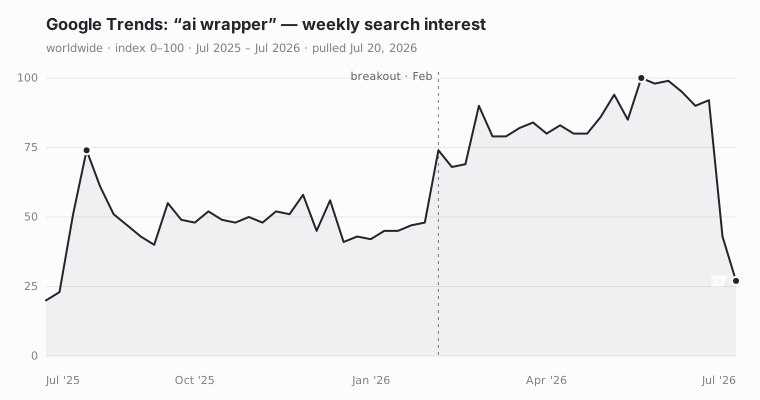 Weekly search interest, worldwide. Google Trends via SerpAPI, pulled July 20, 2026. Last full week shown.
Notice when people search this term: around model releases. That's not a coincidence. It's the whole story. Every frontier release forces the same question on thousands of founders at once: did that update just make my product better, or did it just ship my product as a feature?
The glut behind the anxiety is easy to explain. Building collapsed to a weekend, so wrapping a model in an interface became the default weekend project. More wrappers, more releases, more founders doing the same nervous math every launch day.
The math is answerable in advance. That's the point of this post.
One label, two graveyards
Jasper is the cautionary tale everyone reaches for, and it's worth telling precisely, because the company did almost everything right. It sold AI copywriting before most people had tried AI, built real revenue, and raised $125M at a $1.5B valuation in October 2022. Five weeks later, ChatGPT launched: free, general, and good enough at the core job Jasper charged for. Within a year Jasper had laid off staff, cut its internal valuation by roughly 20%, and replaced its CEO, before pivoting hard toward enterprise marketing teams.
Jasper's value sat in front of the model: it sold access to a capability (decent generated text) that the platform could, and did, hand out for free. There's a running list of products this has happened to; someone maintains it at Killed by OpenAI. The pattern repeats every DevDay: the platform ships a feature, and a hundred products discover they were that feature.
Now the other graveyard's opposite. Cursor is unambiguously a wrapper, an editor built around other companies' frontier models. But its value sits on top of the model: your codebase as context, the edit-test-commit workflow, integrations your team already lives in. When a better model ships, Cursor doesn't get absorbed. It gets a free upgrade, and it reached roughly $2B in annual revenue in about three years, by some measures the fastest scaling in B2B software history.
Same label. The difference isn't code quality, effort, or luck. It's where the value sits relative to the platform's roadmap.
The survival test: four questions
Run your idea through these before the next release day runs it through them for you.
- Play the update forward. The next frontier model ships tomorrow: smarter, cheaper, longer context. Walk through what happens to your product, honestly. If your product gets better, because the model slots into your workflow and upgrades it, you're on the right side. If the update makes your product unnecessary, then your product was compensating for something the model couldn't do yet. You were selling a gap, and gaps close on someone else's schedule.
- Locate the value. Strip away the model call. What's left? If the answer is "a prompt and a nice interface," the value lives in the model, and you're renting it. If what's left is something the platform can't replicate — your data, your integrations, the workflow your users built habits around, your distribution — the value lives with you.
- The settings-toggle question. Could OpenAI or Anthropic ship your product as a checkbox? "Summarize this PDF" became a toggle. "Search the web" became a toggle. Ask whether you're a feature, a product, or a company — and answer at the platform's scale, not yours: a feature worth $10K/month to you is a rounding error they'll give away to sell more subscriptions.
- The 10× price-drop question. Inference gets an order of magnitude cheaper — a thing that has happened repeatedly. Does that widen your margin, or does it arm the hundred clones who charge less because they built your product in a weekend? Cheap intelligence helps you only if the expensive part of your product is something other than intelligence.
Your four answers usually collapse into one sentence: my product is upstream of the updates or my product is in their path.
The two positions, side by side
| Wrapper in the update's path | Wrapper riding the updates | |
|---|---|---|
| Where the value lives | In the model call (access to a capability) | Around it (workflow, context, data, distribution) |
| A better model means | Your product just shipped, for free, to everyone | Your product just improved, for free |
| The moat | Speed to market (temporary by definition) | Something the platform won't build for a niche |
| A weekend clone gets | Basically your product | Your interface, none of your position |
| Canonical case | Jasper vs. free ChatGPT | Cursor on frontier models |
If your idea lands in the left column, that's not automatically a kill. Left-column products can be honest businesses — arbitrage on a gap, run deliberately, exited before the window shuts. What they can't be is accidental. The founders in trouble are the ones running a left-column product on right-column conviction, with three years of roadmap for an eighteen-month window.
Where this shows up in an audit
Update exposure is a moat question, and moat is one of the six dimensions a MakeOrKillIt audit scores, with the reasoning shown and the answers in ranges, not a fake precise number. Describe your idea in plain English and the audit checks live Google demand for the problem, scores defensibility alongside the other dimensions, and builds the strongest case against the idea — which, for a wrapper, is usually some version of "the platform ships this next spring." Better to hear that argument now, from an audit, than next spring, from a changelog.
You get a clear Make / Hold / Kill verdict and the reasons, in minutes. Free, no sign-up.
The next model update is already scheduled. Before it decides for you:
FAQ
Will AI wrappers survive?
Some will, and a few will become very large companies. The label doesn't decide it — position does. Wrappers whose value sits in front of the model (selling access to a capability the platform can ship for free) get absorbed by the next release. Wrappers whose value sits on top of the model (workflow, context, integrations, distribution) get upgraded by the next release. Cursor is a wrapper; it also passed $2B in annual revenue within roughly three years of launch. Ask what a better model does to the product, not what the product is made of.
What are AI wrapper startups?
Products built on top of someone else's AI model: the startup writes the interface, prompts, and workflow, and calls a frontier model's API (OpenAI, Anthropic, Google) to do the intelligent work. The term is usually dismissive, but it describes almost every AI application at launch — including several of the fastest-growing software companies ever. What separates them is whether the product would get better or become pointless if the underlying model improved overnight.
Are AI startups profitable?
A minority are, and the pattern is consistent: profitability tracks moat, not category. Costs are real (inference bills scale with usage) and pricing pressure is real (anything clonable in a weekend gets cloned and undercut). The AI startups with strong margins own something outside the model call — proprietary data, deep workflow lock-in, or distribution. The ones selling a thin layer over an API compete on price against their own clones until the platform ships the feature.
Get the honest read on your own idea.
A reasoned Make / Hold / Kill in minutes — free, no signup.
Score an idea — free →