

July 19, 2026 · 8 min read
You can vibe-code it in a weekend. That's exactly why you should validate first
Vibe coding did something real: it collapsed the cost of building software. An idea that used to cost six months of nights and weekends now costs a weekend and a prompt. Here's what it didn't collapse: the cost of building the wrong thing. That one is unchanged. Months of your attention, spent polishing a product nobody asked for.
So the bottleneck moved. "Can I build this?" was never the hard question, and now it's nearly free to answer. Everything rides on the one question vibe coding can't touch: should you?
When building was expensive, the build itself was a filter. You only started things you'd thought hard about, because starting was costly.
Now nothing filters. Your coding assistant will build anything you describe and never once ask whether anyone wants it. The filter has to come from somewhere else, before the weekend starts. That's idea validation, and it just became the whole game.
Everyone is building. That's the point.
The trend is not subtle. When Andrej Karpathy coined "vibe coding" in February 2025 — "fully give in to the vibes, embrace exponentials, and forget that the code even exists" — it read as a joke about prototyping. Eighteen months later it's a category. We pulled the weekly Google Trends data in July 2026, and the shape is worth reading: a steady baseline near 50 through 2025, a breakout in late February 2026, then four straight months — March through June — running between 80 and 100. Interest eased in the recent July weeks, the same summer dip the term showed a year earlier, and it still sits above last July's baseline.
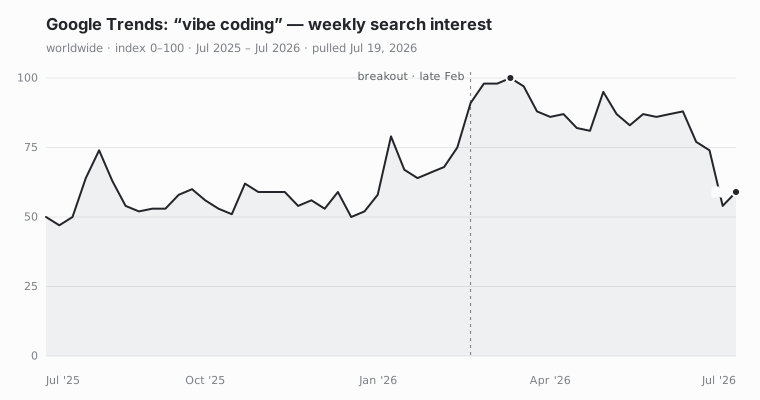 Weekly search interest, worldwide. Google Trends via SerpAPI, pulled July 19, 2026. Last full week shown.
That's not a spike that burned out. That's a behavior that went mainstream and stayed.
The search suggestions around it tell you what stage of the gold rush we're in. Type "vibe coding startup" into Google and autocomplete offers: success, acquisition, valuation, sold. People aren't asking how to do it anymore. They're asking whether it pays.
That's the right question. It's just aimed at the wrong layer.
Cheap building didn't remove the sunk cost. It moved it earlier.
The classic founder failure mode, the build trap, used to take months to develop. You'd code for half a year, fall in love with what you'd made, then defend it against every signal that nobody wanted it. Sunk cost was the disease. Time was the incubation period.
Vibe coding shortens the incubation to one weekend. By Sunday night you have a working product, a landing page, and a name. You are now emotionally invested in an idea that has never once touched the market. And the months you used to spend building? You'll spend them anyway: polishing, adding features, redesigning the onboarding. The product exists now, and abandoning a thing that exists feels like failure in a way that abandoning a document never did. That's the argument for deciding when you'd kill the idea before the weekend starts, while you can still be fair about it.
Nothing about the underlying economics improved. Startups were dying of "no market need" long before anyone vibe-coded anything — it has sat among the top causes in CB Insights' analyses of startup postmortems for a decade, and it has nothing to do with how the product was built. An unwanted product built in a weekend is exactly as dead as an unwanted product built in a year. The weekend just gets you to the graveyard faster, with your optimism still intact.
There's a second blade to this. If you can build it in a weekend, so can everyone else. The same tools that made your MVP nearly free made your competitor's clone nearly free. Code was always a weak moat; vibe coding formally retired it — and if what you're building wraps someone else's model, there's a second survival question worth asking before the weekend. Whatever defensibility your idea has now lives entirely outside the codebase: in distribution, in a niche you actually understand, in demand you found before others did. If you can't name which of those you have, that's not a detail to figure out later.
What changed, and what didn't
| Before AI coding tools | After | |
|---|---|---|
| Cost to build an MVP | Months of work | A weekend |
| Cost of building the wrong thing | Months of your attention | Unchanged — still months |
| Code as a moat | Weak | Effectively zero |
| Competition for any visible niche | Slowed by build cost | A clone is a weekend away |
| Where bad ideas can die cheaply | During the long build | Only before you build |
Read the last row twice. Validation used to be one of several places a bad idea could die early; the grind of a long build killed plenty on its own. Now it's the only checkpoint left. Skip it, and the first honest feedback your idea gets is the market's — months in, after the sunk cost has set.
"But my AI said it was a great idea"
There's a version of validation people think they're doing: describing the idea to the same AI that's about to build it, and feeling encouraged by the response.
This doesn't work, and it fails for a structural reason we've written about at length: a chat model validates you, not your idea. It's trained to be agreeable, it can't see what people are searching for this week, and it will invent a confident score on the spot. Your coding assistant has the same problem with an extra incentive stacked on top: it's built to build. Ask Cursor or Claude whether your idea is worth a weekend and you're asking a very enthusiastic contractor whether you should hire them.
The answer to "should I build this?" has to come from outside the tool that builds it. A fixed method and live market evidence — not the vibes that gave vibe coding its name.
Validate in an afternoon. Then take the weekend.
The good news: at weekend-build speeds, proportionate validation isn't a research project. It's an afternoon. Four steps:
- Read live demand before you write a prompt. Are people actually searching for the problem you solve, and is that interest growing, flat, or dying? This is public data, and checking it is a repeatable method: we walk through it in how to read market saturation off Google demand. Ten minutes here kills more bad weekends than any amount of code review.
- Write the kill case first. Before building, write the strongest honest argument against the idea — the most likely cause of death, named specifically. "Distribution: I have no channel and the niche is dominated by SEO incumbents" is a kill case. "Might not work out" is not. If you can't argue against your own idea, you haven't examined it. You've adopted it.
- Name your moat out loud. The code won't be it. Say what is: an audience you already have, a niche you know from the inside, data nobody else can get, a distribution channel you control. If the sentence comes out empty, the idea isn't ready for a weekend. It's ready for more thinking.
- Set kill conditions before you start. Decide now what result, by what date, means you stop. "If I can't get 10 people to a waitlist in 30 days, I archive it." Written in advance, this is a decision. Improvised later, against sunk cost and a product you're proud of, it becomes a negotiation you will lose.
If you'd rather not grade your own homework — and honestly, the whole problem is that founders can't — that's what MakeOrKillIt is for. Describe the idea in plain English and it runs the audit for you: a knockout check for fatal flaws, scoring in honest ranges, live Google demand pulled in as evidence, and a deliberate, strongest-case argument against the idea. You get a clear Make / Hold / Kill verdict with the reasons, in minutes. Free, no sign-up.
The weekend made building cheap. Spend the afternoon finding out whether this idea deserves one.
FAQ
Do vibe-coded apps make money?
Some do; the success stories are real. Most don't, and the reason is almost never code quality. A vibe-coded app fails the way apps have always failed: nobody wanted it, or the people who wanted it couldn't be reached. Cheap building doesn't change the economics of demand. If anything it makes them harsher, because whatever you can build in a weekend, a dozen other people can too.
Should I validate my idea before vibe coding it?
Yes, and the case is stronger now than it was before AI coding tools. When building took six months, the build itself was a painful but real filter: you only started ideas you'd thought hard about. A weekend MVP removes that filter. Validation is now the only step where a bad idea can die cheaply. An afternoon checking live demand and writing the kill case costs almost nothing next to months spent polishing something nobody searches for.
Is vibe coding good for building a startup?
It's genuinely good for building. Prototypes that took months now take days, and that's real leverage. What it can't do is decide. Your AI coding assistant will happily build anything you describe and will never once ask whether anyone wants it. Vibe coding answers 'can I build this?', which was already the easy question. 'Should I?' still needs a method, live market signal, and permission to say no.
Get the honest read on your own idea.
A reasoned Make / Hold / Kill in minutes — free, no signup.
Score an idea — free →